
Should every language have a Bible translation? The obvious answer to this question is, “Yes.” If all people in the world are to have access to God’s Word, then each language used in the world today should have a Bible translation, right? But some languages are on a path to extinction and do not warrant a translation project. Let’s explore this a bit.
Languages are going extinct
Depending on the source of information, the number of languages in use in the world today varies, but we’ll go with the number given by Ethnologue, a language database maintained by the Summer Institute of Linguistics and recognized as one of the most reliable sources of such data. According to Ethnologue, there were 7,159 living languages in the world in February 2025 (Simons, 2025). Languages can be added to this total as new languages are documented or when two or more languages which were previously thought to be variants of one another are determined to actually be different enough to deserve independent language status. Languages can also be removed from this count, which generally happens when a language goes extinct. Ethnologue notes that between publishing their 2024 and 2025 editions, there were five languages that went extinct (Simons, 2025).
This trend of language extinction is almost certainly accelerating, as the effects of globalization are incentivizing speakers of small languages to abandon their mother tongues in favor of economically and socially advantageous Languages of Wider Communication. Some years ago it was predicted that by the end of the 21st century 90% of the languages spoken in the world would be either extinct or in danger of going extinct (Simons & Lewis, 2013). This prediction is perhaps a bit extreme, but it is a fact that languages are going extinct and will continue to do so. The best estimates from linguistic researchers state that around 43% of living languages are currently endangered. 14% are dying, almost certainly past the point of recovery, while 29% are in trouble and will be lost eventually unless parent-to-child transmission can be strengthened or restored (Ethnologue, 2025).
Assessing translation need
If a language is on the verge of extinction, it does not make sense to begin a Bible translation project, given that most translation projects take years or even decades to finish. If the last remaining speakers of a language are elderly, there may be no one alive to read and benefit from a translation when it is completed. This makes it necessary for each Bible translation project to begin with some kind of assessment to determine the vitality of the language and consequently the need for a Bible translation for a specific language group. Over the years, the linguistic and translation communities have developed some helpful tools for this kind of assessment. One of the better-known tools is the Expanded Graded Intergenerational Disruption Scales or EGIDS. That’s quite a name, but it simply assigns a number value (between 0 and 10) to a language depending on the vitality of that language. The lower the number, the more widely used and robust a language is. Higher numbers (7 and above) mean the language is declining in use and likely on a path to extinction.
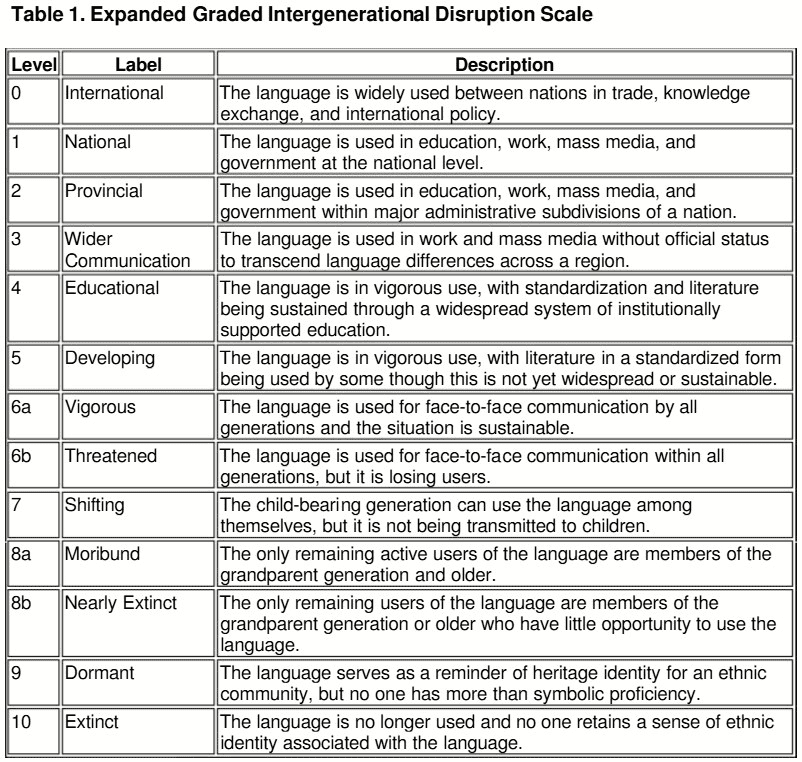
Source: Ethnologue
The Mixtec language group among which I am working ranks as a 6a or 6b on the EGIDS. It is used by all generations in face-to-face communication and is the preferred language for most speakers. Many are proud of their language, and most parents teach it to their children. However, some users of the language leave their hometowns and leave their language behind, ashamed to identify with their indigenous roots and preferring to speak Spanish. A few of the parents intentionally teach their children Spanish as a first language, recognizing that this could help their children get better jobs or succeed in higher education. Whether it should rank as 6a or 6b can actually vary by village, with more isolated villages retaining Mixtec to a higher degree and villages better connected to Spanish speaking areas incorporating Spanish faster. Regardless, since most babies being born today are learning Mixtec as their mother tongue, the language will still be in use for many decades and therefore warrants a Bible translation.
If a language ranks as 8a or 8b on the EGIDS, a full-fledged Bible translation project is probably not justified. Since all speakers of such a language are elderly, by the time the translation was completed, the number of speakers would be considerably reduced, or the language could even be dormant or extinct.
So, are speakers of dying languages doomed to die without ever hearing the Gospel simply because the language is not worth the investment? No, there are options between a full Bible translation and doing nothing. A translation team could work to translate Scripture portions or produce audio recordings. These resources can communicate enough for the Gospel to be understood without requiring the time investment of a full translation. Also, most speakers of dying languages are multilingual. The dying language is being replaced by another more robust language which likely has Scripture resources already available. If many of the remaining speakers of a dying language are also proficient in a second language, this second language can be used to teach them the Bible. Obviously, it is not ideal for anyone to be taught such important truth in anything but their mother tongue, but it may sometimes be the best option in our complex world of shifting language use.
There are many languages that are in a grey zone. They rank as a 7 on the EGIDS and may go extinct within a couple of generations but are still spoken by most of the language community. In these cases, other considerations can help a translation team decide what kind of project to begin. How many people speak this language as their mother tongue? How many of these people are fluent in a second or third language and do good Scripture resources exist in these languages? Are there educated individuals in the language group who can help with the translation effort without much training, accelerating translation? Is there an established church in the language group which will assist the translation effort and guarantee use of a finished translation? These factors and others must be weighed in an assessment. May God give His workers wisdom as they make tough decisions!
— LH
References
Ethnologue. (2025, September 25). How do we classify and measure the status of languages? Retrieved from Ethnologue: https://www.ethnologue.com/insights/classifying-language-status/
Simons, G. F. & Lewis, M. P. (2013). The World’s Languages in Crisis. Studies in Language Companion Series 142, 3-19.
Simons, G. F. (2025, February 21). Welcome to the 28th Edition. Retrieved from Ethnologue: https://www.ethnologue.com/ethnoblog/welcome-28th-edition/